

Liver cyst: when is investigation or surgery necessary?
Understand what a liver cyst (hepatic cyst) is, when it is dangerous, what the symptoms are, how it is investigated, and in which situations liver cyst surgery is indicated.
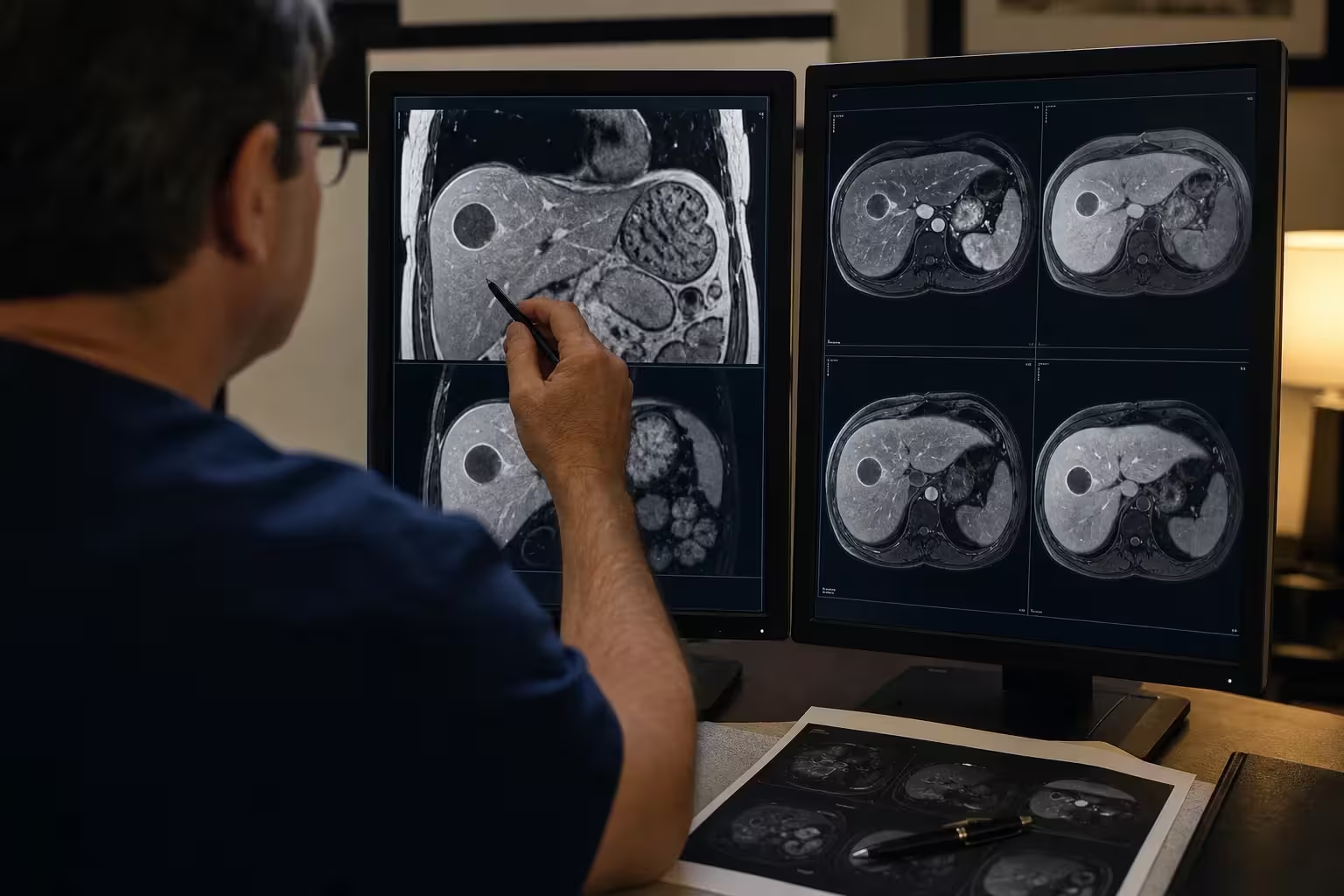
A liver cyst is an increasingly common finding, mainly because of the wide availability of imaging tests such as ultrasound and CT scans. Many people discover they have a hepatic cyst by chance, while having a test for another reason, and this news usually causes concern. The good news is that the vast majority of liver cysts are benign, remain stable, and pose no risk to health. Even so, it is important to understand when a liver cyst only needs monitoring, when it deserves more detailed investigation, and in which situations surgery may be indicated. This text gathers clear and responsible information on the subject — without ever replacing an individual assessment by a physician.
What a liver cyst is
A liver cyst is a cavity, usually rounded and filled with fluid, that forms within the tissue of the organ. Most of the time it is a sac of liquid content, with thin, well-defined walls. Cysts may be single or multiple, and their size varies widely: from a few millimeters, with no consequence at all, to larger formations that can, in specific situations, cause symptoms. The mere presence of a cyst does not mean serious disease; what matters is defining the type of cyst and its characteristics.
Types of liver cyst
Not every hepatic cyst is the same, and telling them apart is the most important step in the evaluation. Knowing the main types helps explain why some require only observation and others deserve special attention.
Simple cyst
The simple cyst is by far the most common type. It usually has thin walls, clear liquid content, and regular contours, without signs suggesting anything more complex. In the vast majority of cases it is benign, does not turn into cancer, and remains stable over the years. Many people live with a simple cyst their whole life without any problem, with monitoring only when necessary.
Complex cyst
We speak of a complex cyst when the imaging test shows characteristics different from those of a simple cyst: thicker walls, septa (internal divisions), calcifications, nodules in the wall, or content with an irregular appearance. These findings do not, on their own, mean something serious, but they indicate the need for more careful investigation to clarify the nature of the cyst and define the best approach.
Polycystic liver disease
In some people, the liver has multiple cysts, a condition known as polycystic liver disease. It may run in families and is sometimes associated with cysts in the kidneys as well. In most cases, even with many cysts, liver function is preserved and the approach is monitoring. In situations where the volume of the cysts causes significant discomfort, individualized treatment options are evaluated.
Parasitic cysts
There are also cysts of parasitic origin, such as the hydatid cyst, related to certain infections and more frequent in some regions. They have their own characteristics on imaging tests and require a specific approach, different from that of simple cysts. For this reason, the patient's history and careful analysis of the images are essential to identify these cases.
Causes and why cysts form
Most of the time, the simple liver cyst is considered a congenital alteration, that is, present since the development of the organ, even though it is only discovered in adulthood. It is not caused by a specific habit, by diet, or by anything the person did wrong. Polycystic disease frequently has a genetic component. Parasitic cysts, in turn, are linked to specific infections. Understanding the likely origin helps the physician define whether the finding is just a benign variation or whether it deserves additional investigation.
Is a liver cyst dangerous?
This is the question that most worries those who receive the diagnosis, and the answer, in most cases, is reassuring. The simple cyst, the most common, is generally not dangerous: it tends to be benign, stable, and without impact on health. What requires more attention are cysts with complex characteristics, those that grow significantly, those that cause symptoms, or those whose nature is not clear on the initial tests. In these cases, appropriate investigation is what makes it possible to set concerns aside or, when necessary, to plan treatment safely.
Symptoms of a liver cyst
Most liver cysts are asymptomatic, meaning they cause no symptoms at all. That is why so many are discovered by chance. When symptoms do appear, they are usually related to the size of the cyst or to the pressure it exerts on neighboring structures. Among the possible complaints are:
- Discomfort or pain in the upper right side of the abdomen.
- A feeling of heaviness, fullness, or a mass in the abdomen.
- A sense of fullness or early satiety, when a large cyst presses on the stomach.
- Nausea or discomfort after meals, in specific cases.
It is worth remembering that these symptoms are nonspecific and may have many other causes. Their presence does not necessarily mean the cyst is dangerous, but it does indicate that it is worth investigating whether or not it is responsible for the discomfort.
Warning signs that warrant evaluation
Some signs indicate the need for prompt medical evaluation: strong, sudden abdominal pain, fever, yellowing of the eyes and skin (jaundice), rapid increase in abdominal volume, or significant malaise. These situations may suggest less common complications, such as bleeding, infection, or significant compression, and warrant medical attention for clarification.
How the cyst is usually discovered
In practice, most hepatic cysts are discovered incidentally, that is, without the person having any suspicion. This happens when an abdominal imaging test is requested for another reason — a routine ultrasound, an investigation of abdominal pain, or a check-up — and the cyst appears as an unexpected finding. This type of discovery is increasingly common and, most of the time, corresponds to simple, benign cysts.
How the investigation is done
The investigation of a liver cyst starts with abdominal ultrasound, a painless test, without radiation and widely available, able to show the presence, size, and several characteristics of the cyst. In many cases of a typical simple cyst, this test is already enough to provide reassurance and define the follow-up.
When there are doubts about the nature of the cyst, or when it has complex characteristics, the physician may request more detailed tests, such as CT scan or magnetic resonance imaging. These methods offer more precise images of the walls, septa, and content of the cyst, helping to distinguish a simple cyst from one that needs special attention. In specific situations, blood tests may also be useful. The choice depends on each patient's situation.
Benign features and features that call for attention
In general, some aspects observed on the tests help guide the approach. Cysts with thin walls, homogeneous liquid content, and regular contours, without nodules or thick septa, tend to be benign and stable. On the other hand, thick or irregular walls, coarse septa, calcifications, nodules in the wall, heterogeneous content, or significant growth over time are characteristics that call for more careful investigation. It is important to stress that no single finding defines the diagnosis: the evaluation takes into account all the information together and the patient's history.
When to just observe and when to operate
The vast majority of liver cysts do not require surgery. For simple, asymptomatic cysts with benign characteristics, the usual approach is observation, with follow-up imaging when indicated. In many cases, once the benign and stable nature is confirmed, follow-up may be spaced out or even discontinued, according to medical evaluation.
More in-depth investigation and the possible indication of treatment are usually considered in situations such as:
- Cysts that cause significant symptoms, such as persistent pain or a marked feeling of heaviness.
- Large cysts that compress neighboring structures, such as the stomach or bile ducts.
- Cysts with complex or atypical characteristics on imaging.
- Significant growth or change in appearance during follow-up.
- Suspicion of a cyst of parasitic origin or of another specific nature.
- Complications, such as infection or bleeding within the cyst.
The decision between observing and intervening is always individualized and should be made together with a surgeon of the digestive system and liver, who will assess the tests, the symptoms, and the full context of each person.
What liver cyst surgery is like
When treatment is indicated, there are different approaches, chosen according to the type, size, and location of the cyst and the characteristics of each patient. In lay terms, the most common options include:
- Cyst deroofing (fenestration): removing part of the cyst wall to drain the fluid and reduce pressure, frequently performed by laparoscopy, a minimally invasive technique.
- Resection of part of the cyst or, in specific situations, of a segment of the liver, when the characteristics require it.
- Image-guided procedures, such as drainage, considered in selected cases.
- Specific approaches for parasitic cysts, with their own precautions.
It is important to understand that there is no single technique for every case, and that the choice depends on a careful evaluation. The goal of treatment is to relieve symptoms or resolve the problem safely, always based on the characteristics of each cyst, without promises of outcomes that fail to consider the individuality of each patient.
Recovery and follow-up
When the approach is minimally invasive, such as laparoscopy, recovery is usually faster than after open surgery, with less pain and an earlier return to activities. Even so, recovery time varies according to the type of procedure, the characteristics of the cyst, and each body's response. After treatment, follow-up with tests may be recommended to confirm the good result and monitor the liver. In cases where the approach is observation, periodic follow-up is what ensures safety over time.
Common myths about liver cysts
Some misconceptions about the subject deserve clarification. It is not true that every liver cyst is cancer or will turn into cancer — the vast majority are benign and do not behave that way. Nor is it true that every cyst needs to be operated on; in most cases, monitoring is enough. Likewise, there are no teas, diets, or home remedies capable of 'dissolving' a hepatic cyst; products making such promises have no proven effectiveness and can delay proper evaluation.
Frequently asked questions about liver cysts
Is a liver cyst dangerous?
Most of the time, no. The simple cyst, the most common, tends to be benign and stable, with no risk to health. Special attention goes to cysts with complex characteristics, those that grow, those that cause symptoms, or those whose nature needs to be clarified. Medical evaluation is what defines the level of concern in each case.
Can a liver cyst turn into cancer?
The simple, benign cyst does not usually turn into cancer. Concern about malignancy is restricted to specific situations, with atypical characteristics on the tests, which for that reason deserve more detailed investigation. This is precisely why correct characterization of the cyst is so important.
Does every liver cyst need surgery?
No. The vast majority of hepatic cysts, especially simple and asymptomatic ones, are only monitored. Surgery is usually considered when there are significant symptoms, large cysts, complex characteristics, significant growth, or complications. The decision is always individual.
Do I need to repeat tests if I have a simple cyst?
It depends. For typical, stable simple cysts, the physician may recommend only an initial follow-up and, depending on the result, space out or discontinue further tests. For cysts with some doubt, follow-up imaging helps confirm stability over time. The guidance should be individualized.
When to see a specialist
If you have discovered a liver cyst — even without symptoms — it is worth talking to a surgeon of the digestive system and liver to understand the meaning of the finding in your case. Specialized evaluation is especially indicated when the cyst has complex characteristics, causes symptoms, is sizable, or grows over time. Bringing your existing test results, a description of your symptoms, and your written questions to the appointment helps make the assessment more objective and the choice of approach more precise.
Understanding what a liver cyst is helps you face the diagnosis more calmly. In most cases, it is a benign finding that requires only monitoring. When doubts or features that call for attention arise, there is time to investigate carefully and to plan, if necessary, the best path alongside an experienced professional — avoiding both unnecessary alarm and the neglect of a case that deserves care.
Do you have questions about your case?
A specialized evaluation helps understand the best path, with clarity and security.