

Robotic surgery: how it works, advantages, and indications
Robotic surgery: understand how the surgeon-controlled platform works, how it differs from laparoscopy, and its indications in the digestive system.
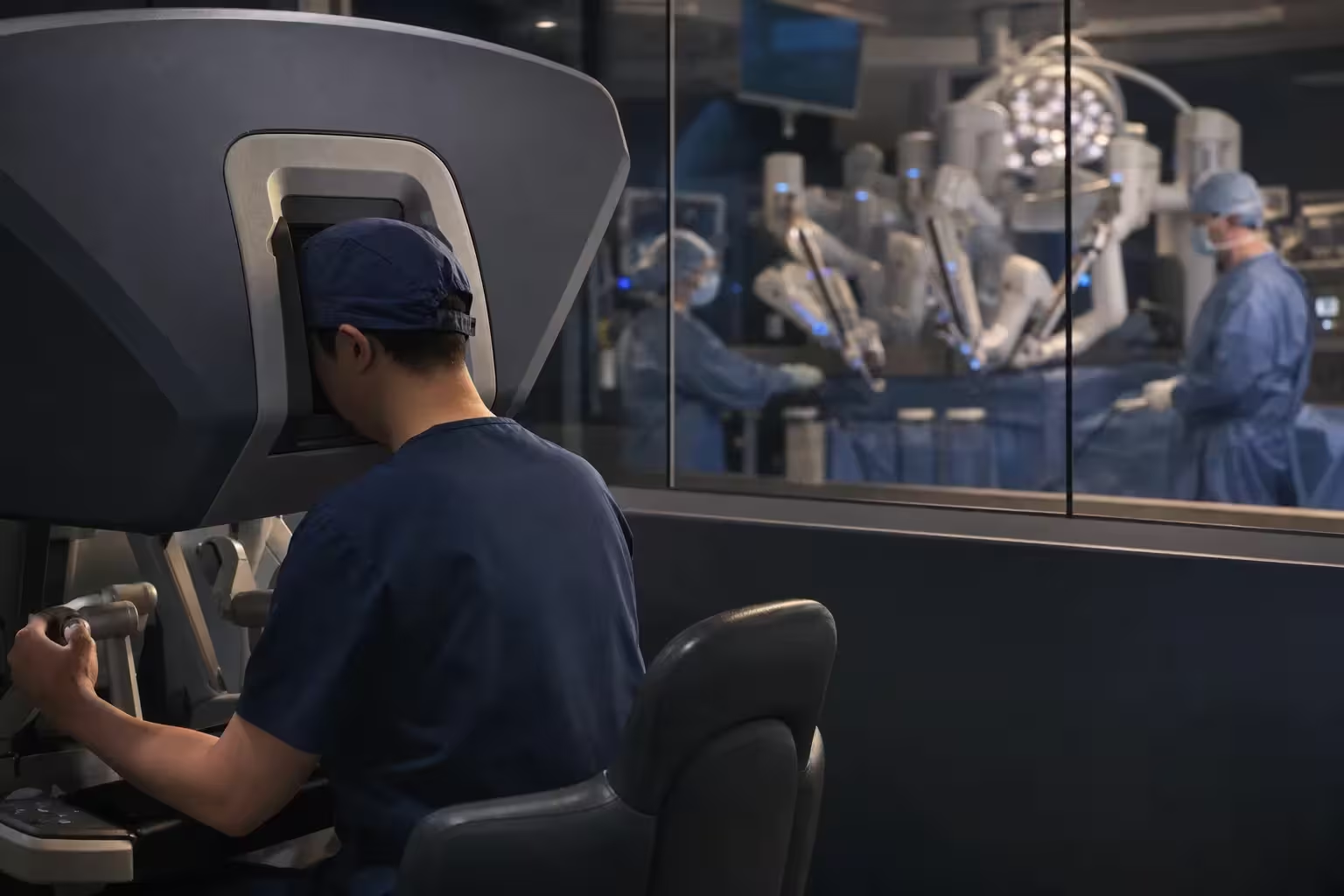
Robotic surgery sparks a great deal of curiosity — and, at times, mistaken expectations. It is common to picture a machine operating on its own, without human involvement, but the reality is quite different. Robotic surgery is a minimally invasive technique in which the surgeon controls, from start to finish, delicate instruments through a console. The aim of this text is to explain, clearly and responsibly, what robotic surgery is, how the platform works, how it differs from laparoscopy and open surgery, what its potential advantages are in selected cases and, equally important, what it does not mean. This is educational content that does not replace an individual assessment by a physician.
What robotic surgery is
Robotic surgery, also called robot-assisted surgery, is an evolution of minimally invasive techniques. As with laparoscopy, the procedure is performed through small incisions, without the need for a large cut. The central difference lies in how the instruments are handled: instead of holding them directly with the hands, the surgeon operates from a console, commanding articulated arms that reproduce, inside the patient's body, the movements made at the controls. It is essential to understand from the outset that the platform does not decide or carry out anything on its own — it simply translates, with precision, the commands of the person operating.
How the robotic platform works
The robotic platform is generally made up of three parts that work together. The console is where the surgeon sits, views the magnified image, and commands the movements. The cart with the robotic arms stays next to the patient and holds the camera and the instruments introduced through the small incisions. Finally, there is the video and processing tower, which integrates the image and allows the entire team in the room to follow the procedure. This set-up was designed to provide stability and fine control during the operation.
Three-dimensional vision and image magnification
One of the most notable features of robotic surgery is magnified three-dimensional vision. While traditional laparoscopy usually works with a two-dimensional image, the robotic platform offers depth and a significant magnification of the structures. This can help the surgeon identify vessels, nerves, and delicate anatomical planes more clearly, especially in hard-to-reach areas. Image quality is one of the elements that make the technique appealing for procedures requiring fine dissection.
The articulated instruments
The instruments used in robotic surgery have joints that reproduce, and in certain respects extend, the range of motion of the human wrist. This allows the surgeon to rotate, angle, and reach positions that would be difficult with the straight instruments of conventional laparoscopy. In addition, the platform tends to filter out small natural hand tremors, which contributes to steadier movements. These features do not replace the surgeon's skill; they function as tools that, in the right hands, can facilitate certain stages of the procedure.
The surgeon in command: not an autonomous robot
It is worth reinforcing an essential point: in robotic surgery, the one operating is always the surgeon. The word 'robot' can create the false impression of autonomy, but the platform has no ability to make decisions, choose approaches, or act without a command. Every movement of the instruments corresponds directly to a movement made by the surgeon at the console, in real time. The surgical team stays beside the patient throughout the procedure, ready for any need. Therefore, the experience, clinical judgment, and training of the person operating remain the most important factors for safety and outcome.
Differences between robotic surgery, laparoscopy, and open surgery
To understand where robotic surgery fits, it helps to compare it with the other approaches. In traditional open surgery, access is made through a larger incision, allowing the surgeon to see and touch the organs directly. It is a well-established technique and, in many situations, remains the most suitable. Laparoscopy, in turn, is minimally invasive: it uses small incisions, a camera, and long instruments, with recovery that is generally faster than open surgery.
Robotic surgery belongs to the group of minimally invasive techniques, like laparoscopy, but adds three-dimensional vision, image magnification, and articulated instruments controlled from the console. It is not a technique that makes the others obsolete: each approach has its own indications, advantages, and limitations. The choice depends on the type of operation, the patient's characteristics, the availability of resources, and the team's experience.
Potential advantages in selected cases
In specific situations, robotic surgery may offer some potential advantages. It is important, however, to treat these as possibilities in selected cases, not as guarantees that apply to everyone. Among the benefits frequently discussed in the literature are:
- Small incisions, similar to those of laparoscopy, with less trauma to the abdominal wall.
- Magnified three-dimensional vision, which may help with delicate dissections and in hard-to-reach areas.
- Greater range and stability of instrument movement in certain procedures.
- Potential precision in narrow anatomical regions, such as the pelvis.
- The possibility, in certain cases, of less postoperative pain and an earlier return to activities, similar to what is observed with other minimally invasive techniques.
These advantages depend heavily on the type of surgery, the clinical case, and the surgeon's experience. In some operations, the benefits over well-performed laparoscopy may be subtle; in others, more evident. For this reason, the decision must always be individualized, without promises of results.
What robotic surgery does not mean
Just as important as knowing the advantages is understanding the limits. Robotic surgery is not automatically the best option for everyone or for every type of operation. It does not eliminate the possibility of complications, which exist in any surgical procedure, regardless of the technique. Nor is it synonymous with a superior result in every situation: in many cases, conventional laparoscopy or open surgery may be equally suitable or even preferable.
In the same way, the robotic approach does not remove the need for careful indication and a well-trained surgeon. Technology is a means, not an end. Be wary of messages that present robotic surgery as a miracle solution or as free of risk. The responsible course is to analyze each case and choose the technique that offers the best balance between safety and benefit for that patient.
Common indications in the digestive system and abdomen
Abdominal robotic surgery has been applied in various areas, including procedures of the digestive system. Among the situations in which robotic digestive surgery may be considered, always according to the individual assessment, are operations involving the stomach, intestine, esophagus, liver, pancreas, bile ducts, and abdominal wall hernias. It is also used in colorectal surgery and in procedures that require dissection in narrow anatomical spaces.
It is important to make clear that the existence of a possible indication does not mean the robotic technique is mandatory or universally superior in that context. For each of these conditions, the surgeon assesses whether the patient would benefit from the robotic approach, laparoscopy, or open surgery, considering the full clinical picture. The correct indication is what sustains a good result — far more than the technology itself.
The importance of surgeon training and correct indication
No platform, however advanced, operates on its own. The decisive factor remains the robotic surgeon and their team. Proper use of the technology requires specific training, a learning curve, and experience both in the minimally invasive technique and in handling the platform. A well-prepared professional knows how to recognize when the robotic approach adds value and when another approach is more appropriate — including when it is prudent to convert to another technique during the procedure, if necessary, always prioritizing safety.
For this reason, rather than simply asking whether a given surgery can be robotic, it is reasonable to discuss the team's experience with that specific type of operation, the alternatives available, and the reasons a technique is being recommended over another. A good indication arises from the dialogue between technical assessment and the patient's needs.
How the individual decision is made
Choosing the surgical technique is an individual and shared decision. Several factors go into this analysis: the type and complexity of the disease, the patient's anatomy and clinical condition, previous surgeries, the presence of adhesions, the goal of the procedure, and the availability of resources. There is no single answer that suits everyone. What works very well for one person may not be ideal for another, even with similar diagnoses.
In this process, the surgeon's role is to present the options transparently, explain the advantages and limitations of each, and help the patient understand the reasoning behind the recommendation. Bringing your written questions and your existing test results makes this conversation more objective and worthwhile.
What recovery may involve
Because it is a minimally invasive technique, recovery from robotic surgery tends to follow a pattern similar to laparoscopy: small incisions, generally manageable postoperative pain, and the possibility of a progressive return to activities. Even so, recovery time varies considerably depending on the type of operation performed, the patient's general condition, and whether or not complications arise. A simpler procedure usually has a different recovery from a complex surgery, even if both are done through the same approach.
The postoperative instructions — care of the incisions, resuming eating, pain control, and returning to work and physical activity — are individualized and provided by the responsible team. Following these recommendations and attending follow-up appointments is an essential part of a safe recovery, regardless of the technique used.
Useful questions to bring to your consultation
Faced with the possibility of surgery, preparing a few questions helps you take part in the decision in a more informed and calm way. There is no silly question, and a good professional will be glad to clarify each point clearly. The idea is not to memorize technical terms, but to understand the reasoning behind the recommendation. Among the questions that tend to be useful are:
- What are the technique options for my case — open, laparoscopic, or robotic — and why is one of them being recommended?
- What are the possible advantages and limitations of each approach in my specific situation?
- What is the team's experience with this type of procedure?
- What is recovery usually like, and what care will I need afterward?
- What are the risks involved, and what can be done to reduce them?
- What happens if, during the operation, it becomes necessary to switch techniques?
Bringing these questions in writing, together with your existing test results and the list of medications you take, makes the consultation more objective. A well-made surgical decision arises from dialogue: on one side, the surgeon's technical assessment; on the other, the patient's questions, values, and expectations. Feeling secure and informed about the proposed plan is an important part of the whole process, regardless of the technique chosen.
Frequently asked questions about robotic surgery
Does the robot operate on its own?
No. At no point does the platform act autonomously. All movements are commanded by the surgeon from the console, in real time, with the team beside the patient. The technology translates the commands with precision, but does not make decisions.
Is robotic surgery always better than laparoscopy?
Not necessarily. In many situations, well-performed laparoscopy offers equivalent results. The robotic approach may bring advantages in selected cases, especially in delicate dissections or in narrow spaces, but the best technique depends on the procedure, the patient, and the team's experience.
Does robotic surgery eliminate the risk of complications?
No. No surgical technique is free of risks. The robotic approach may contribute precision and magnified vision in certain procedures, but complications are possible in any surgery. That is why the correct indication and appropriate follow-up are so important.
Can any digestive system surgery be robotic?
Not always. Although abdominal robotic surgery has broad applications, the indication depends on the type of disease, the patient's condition, and the team's assessment. In some cases, another approach may be more suitable. The decision is always individual.
When to see a specialist
If you have been advised to undergo digestive system or abdominal surgery and have questions about the available techniques — including robotic surgery — it is worth talking to a surgeon experienced in minimally invasive surgery. A specialized assessment makes it possible to understand which approach offers the best balance between safety and benefit for your specific case, to clarify expectations, and to clear up any confusion caused by inaccurate information. Bringing your test results, your history, and your written questions helps make the appointment more productive and the decision more informed.
Understanding what robotic surgery is helps form realistic expectations and take part in decisions with greater peace of mind. It is a valuable tool within the range of minimally invasive techniques, with potential advantages in selected cases — always in service of a good indication, a well-trained surgeon, and what is safest for each patient.
Do you have questions about your case?
A specialized evaluation helps understand the best path, with clarity and security.