

Pancreatic cancer: early symptoms, diagnosis, and treatment
Understand what pancreatic cancer is, why early symptoms are often subtle, how the diagnosis is made, and what the treatment options are within multidisciplinary care.
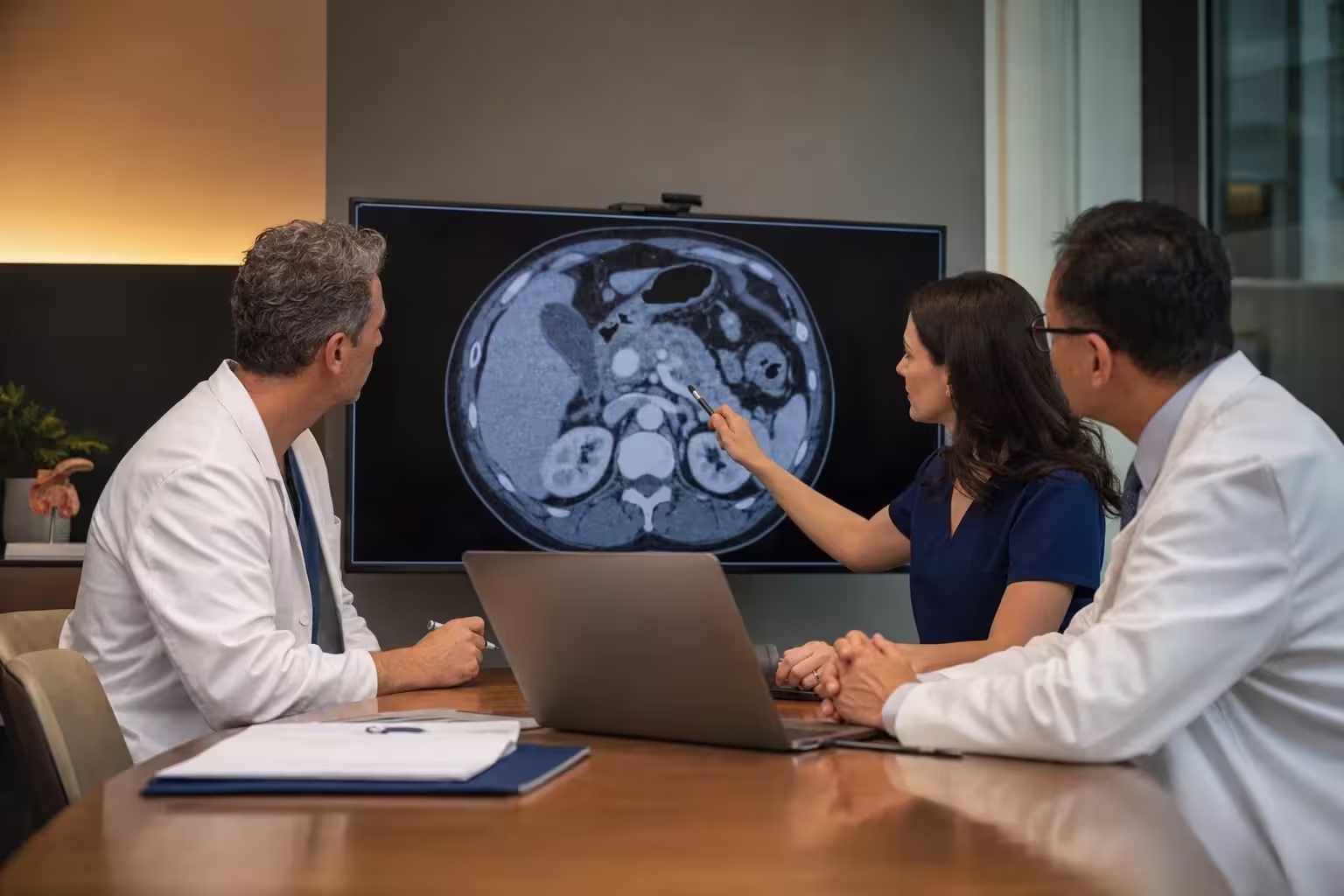
Pancreatic cancer is one of the digestive system tumors that causes the most concern, largely because its early symptoms tend to be subtle and nonspecific. Many people live for weeks or months with mild signs — a different digestion, a new tiredness, unexplained weight loss — before the possibility is even raised. Understanding what pancreatic cancer is, what the early signs of pancreatic cancer are, and how the diagnosis is made helps you seek evaluation at the right time and make decisions with more clarity. This text gathers responsible, up-to-date information for an educational purpose, without ever replacing an individual assessment by a physician. The intent is not to alarm, but to guide: not every abdominal symptom is cancer, but some signs deserve careful investigation.
What the pancreas is and what it does
The pancreas is an elongated gland located in the upper abdomen, behind the stomach, in close relation with the duodenum, the liver, the bile ducts, and important blood vessels. Though discreet, it performs two essential functions. The first is digestive: it produces enzymes that help break down the fats, proteins, and carbohydrates in food, released into the intestine through a channel called the pancreatic duct. The second is hormonal: it makes insulin and other hormones that regulate blood sugar. Because of this deep location and its proximity to vital structures, changes in the pancreas do not always produce obvious symptoms in the early stages, which makes understanding the organ especially important.
What pancreatic cancer is
Pancreatic cancer arises when cells of the organ begin to multiply in a disordered way, forming a tumor. The most common type originates in the cells that line the pancreatic ducts, but there are other varieties, including less frequent tumors with distinct behavior. The location of the tumor within the pancreas — head, body, or tail — influences the symptoms that appear. Tumors in the head of the pancreas, for example, may compress the bile duct and cause jaundice earlier, while tumors in the body or tail tend to develop even more silently. It is important to remember that not every nodule or change in the pancreas is cancer: there are cysts and benign lesions that also require evaluation but follow completely different paths.
Why pancreatic tumors require attention
Concern about pancreatic cancer is linked, in part, to the fact that it is often discovered at more advanced stages, precisely because the early symptoms are nonspecific. This reinforces the value of investigating persistent signs and of having a specialized evaluation. At the same time, it is essential to keep a balanced perspective: digestive symptoms are very common in the population and, in the vast majority of cases, have benign causes. The role of investigation is precisely to tell these situations apart safely.
Why the first symptoms are so subtle
Unlike more superficial organs, the pancreas sits in a deep region of the abdomen, surrounded by other structures. A tumor may grow for some time without causing intense pain or visible signs. In addition, many of the early symptoms — such as heavy digestion, vague abdominal discomfort, or tiredness — are easily confused with everyday complaints and with far more common benign conditions. For this reason, more than an isolated symptom, what tends to draw attention is the persistence and combination of signs over time, especially when they appear without a clear explanation.
Symptoms and early signs of pancreatic cancer
The symptoms of pancreatic cancer vary according to the location and stage of the tumor. None of them, on its own, confirms the diagnosis, but some deserve attention when they are persistent or appear together:
- Jaundice: yellowing of the eyes and skin, often accompanied by dark urine, pale stools, and itching, when the tumor affects the flow of bile.
- Involuntary weight loss, without changes in diet or increased physical activity.
- Pain in the upper abdomen that may radiate to the back, sometimes worsening after meals or when lying down.
- Loss of appetite and an early feeling of fullness.
- Digestive changes, such as greasy, pale, floating stools, nausea, or difficulty digesting fats.
- The onset of diabetes in a person with no prior history, or unexplained worsening of already controlled diabetes.
- Persistent tiredness and a general feeling of being unwell.
Signs that warrant evaluation without delay
Painless jaundice — the yellowing that appears without associated pain — is a sign that should always be investigated, since it may indicate obstruction of the bile ducts. Likewise, the combination of significant weight loss, persistent abdominal pain radiating to the back, and the recent onset of diabetes in adults, especially past a certain age, is a set of findings that justifies careful medical evaluation. Again: these signs have many possible causes, most of them benign, but their persistence calls for investigation rather than waiting.
Risk factors for pancreatic cancer
The disease is multifactorial and, in most cases, it is not possible to point to a single cause. Some factors, however, are associated with a higher likelihood, even though they do not cause the problem in isolation:
- Smoking, one of the most consistently related risk factors.
- Older age, since most cases occur beyond a certain age range.
- Family history of pancreatic cancer or certain hereditary syndromes.
- Chronic pancreatitis, a prolonged inflammation of the organ.
- Long-standing diabetes and obesity.
- Excessive alcohol consumption and a diet low in fiber and high in ultra-processed foods.
How the diagnosis is made
When there is suspicion, the investigation combines the clinical history, the physical examination, and complementary tests. There is no single test that resolves every doubt; the diagnosis is built from a set of information. Among the most widely used resources are:
- Imaging studies, such as computed tomography and magnetic resonance imaging, which help locate and characterize the tumor and assess its relationship with nearby vessels and organs.
- Endoscopic ultrasound, which brings the device close to the pancreas from within the digestive tract and allows detailed images and, when needed, sample collection.
- MR cholangiography, a study that examines the bile ducts and the pancreatic duct.
- Tumor markers in the blood, which may assist in follow-up but do not confirm or rule out the diagnosis on their own.
- Biopsy, that is, the analysis of a tissue sample, which is often necessary for confirmation in many situations, especially before certain treatments.
The choice and sequence of these tests depend on each case. An essential point is what is called staging: understanding the extent of the disease, whether it is confined to the pancreas or whether other structures are involved. This step is decisive for defining the treatment strategy and should be carried out by an experienced team.
The importance of specialized multidisciplinary evaluation
Pancreatic cancer is one of the conditions in which multidisciplinary care makes a real difference. This means bringing together professionals from different areas — digestive and hepatobiliary surgery, clinical oncology, radiation therapy, radiology, endoscopy, pathology, nutrition, and supportive care — to discuss each case together. This coordinated discussion helps define whether the tumor is amenable to surgery, what the best sequence of treatments is, and how to preserve quality of life as much as possible. Decisions made in isolation tend to be less complete than those built by a team that analyzes the same case from different angles.
Overview of pancreatic cancer treatment
The treatment of pancreatic cancer is always individualized and depends on factors such as the type and location of the tumor, the extent of the disease, and the person's general health. There is no single approach applicable to everyone, and that is precisely why specialized, multidisciplinary evaluation is so valued. In general terms, the main treatment modalities include surgery, chemotherapy, and radiation therapy, often combined in a planned strategy.
Surgery, when the tumor is resectable
When the evaluation shows that the tumor is confined and can be removed safely, surgery is considered. For tumors located in the head of the pancreas, one of the best-known procedures is the so-called pancreaticoduodenectomy, popularly associated with the name Whipple surgery. In simple terms, it is a major operation in which the affected portion of the pancreas is removed along with neighboring structures, followed by reconstruction of the digestive tract. For tumors in the body or tail, other techniques may be indicated. These are complex surgeries that require an experienced team and adequate infrastructure, and whose indication depends on careful planning.
Chemotherapy, radiation therapy, and combined treatments
Chemotherapy and, in specific situations, radiation therapy are part of care in many cases. They may be used before surgery, to try to shrink the tumor and make removal easier, or afterward, with the goal of treating the disease more broadly. In situations where surgery is not indicated, these therapies take on a central role in controlling the disease and relieving symptoms. Deciding which approach to follow, in what order, and for how long is part of the multidisciplinary plan, always discussed with the patient.
The value of reaching a reference center
Because it is a complex disease, pancreatic cancer is usually best managed in services with specific experience in the subject, where there is case volume, an integrated multidisciplinary team, and infrastructure for highly complex procedures. The medical literature recognizes that, in pancreatic surgery, the experience of the team and the center is associated with safer care. This does not mean that only large centers matter, but rather that seeking a specialized evaluation, especially when surgery is being considered, is a prudent decision. It is worth talking openly with your doctor about where and by whom the treatment will be carried out.
Supportive care and quality of life
Regardless of the stage, caring for symptoms and well-being is an essential part of treatment. This includes pain management, nutritional support — often with pancreatic enzyme replacement to improve digestion —, control of diabetes when present, and emotional support for the patient and family. So-called supportive care does not oppose tumor treatment; the two go hand in hand and help the person go through the process with more comfort and dignity. Asking for help with these matters is not a sign of weakness, but part of complete care.
Frequently asked questions about pancreatic cancer
Does back pain always indicate pancreatic cancer?
No. Back pain is an extremely common symptom and, in the vast majority of cases, has muscular, postural, or orthopedic causes. In the context of pancreatic cancer, what draws attention is persistent pain in the upper abdomen that radiates to the back, usually accompanied by other signs such as weight loss. An isolated symptom is not a reason to panic, but persistence justifies an evaluation.
Can diabetes that appears suddenly be a sign of cancer?
The recent onset of diabetes, especially in older adults without typical risk factors, is one of the signs that may, in some cases, be associated with changes in the pancreas. This does not mean that all new diabetes indicates cancer — the vast majority does not have that connection. But, faced with this picture combined with other symptoms, the doctor may consider investigating the pancreas.
Is there a routine test to detect pancreatic cancer in everyone?
For the general population, there is no widely recommended screening test as there is for other tumors. Investigation is usually guided by symptoms or by specific risk factors, such as a strong family history or certain hereditary syndromes. In these particular groups, follow-up may be individualized by a specialized team.
Is every pancreatic tumor malignant?
No. There are benign lesions and cysts in the pancreas that are not cancer, as well as less frequent tumors with varying behaviors. For this reason, finding a change in the pancreas on a test does not, in itself, mean a cancer diagnosis. Proper characterization, carried out by specialists, is what defines the nature of the lesion and the course of action.
When to see a specialist
If you have persistent symptoms without a clear explanation — such as jaundice, involuntary weight loss, abdominal pain radiating to the back, significant digestive changes, or the recent onset of diabetes — it is worth seeing a digestive system surgeon or a specialist in diseases of the pancreas and bile ducts. The same applies to anyone who has discovered a change in the pancreas on a test and wants to understand its meaning. Specialized evaluation makes it possible to investigate methodically, avoid both unnecessary alarm and harmful delay, and define the next steps based on the full picture. Bringing your existing test results, a list of symptoms with their dates, and your written questions to the appointment makes the assessment more objective.
Understanding pancreatic cancer with honest information is a way to reduce anxiety and act with more clarity. The disease is serious and deserves respect, but there are diagnostic and treatment resources, prepared teams, and care that make a difference throughout the entire process. The most important step, in the face of persistent signs, is not to postpone the evaluation — and to carry it out with someone experienced in the subject, in a careful and individualized way.
Do you have questions about your case?
A specialized evaluation helps understand the best path, with clarity and security.